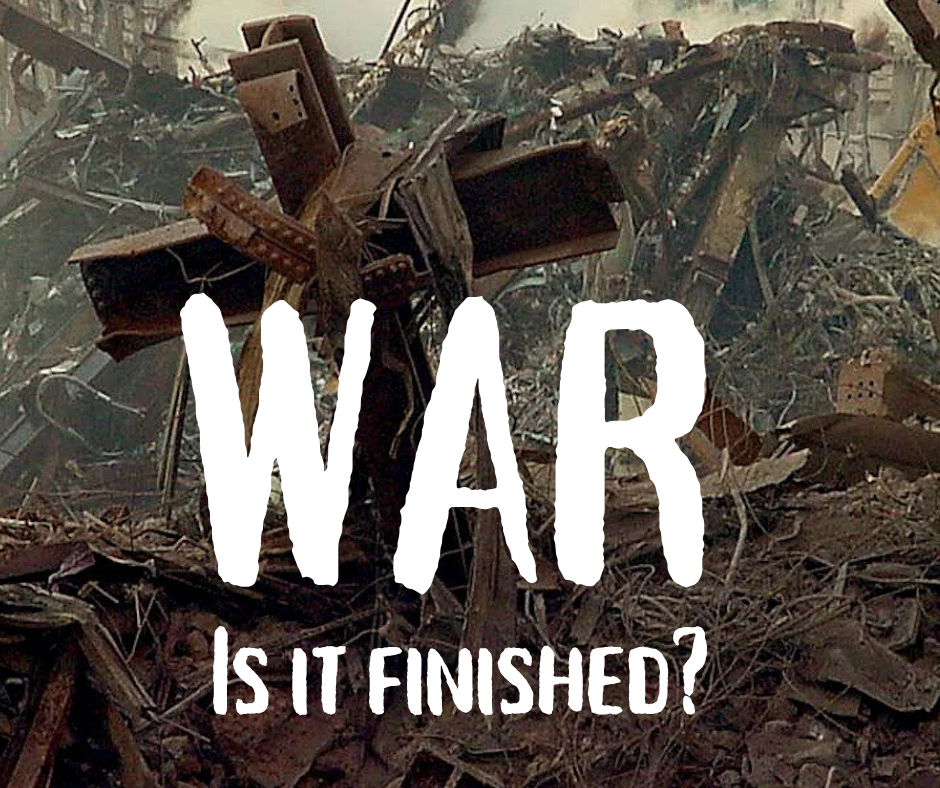

War. Is it finished?

Every night, we heard about the war in Iran. While some leaders gathered to pray for victory, assuming that a triumphant war must be the will of God, the Pope said it was not. Whose right? Could they both be right? In all things, there are three things at play.

God's Moral will: What God wills is always good, holy, and life‑giving. Eden reflects this. That is the world as God meant it. War is never God’s moral will.

Human Free will: Given by God to honour us, but because of our choices, we see sin, rebellion, and therefore war.

God's Sovereign will: This is His unstoppable plan that He brings about in history. Like the wars in the Old Testament. These were His sovereign will, not His moral desire. They were limited, necessary acts of discipline or judgment within Israel, and among nations that threatened the covenant and the Messianic line. Now that Messiah has come, God invites the world to come to Him. God has not changed; the covenant has.  God may have fought for His people in the Old Testament, but in the New Testament, God died for His enemies. Even the ones shouting “Crucify Him” (or death to America).

Can any war now be “just?” Augustine taught that a legitimate authority can declare war if the aggressor's harm would be lasting, grave, and certain, but must be fought to restore peace, not pursue hatred or conquest. Thus, wars that might qualify as “just” are defensive wars against clear invasion, or interventions to stop genocide when diplomacy has failed. Legitimate governments, such as Israel and America, may have reason to believe they are defending Israel or the world from great evil or resisting grave injustice against Iran's citizens. That is the government's role. But the Church’s calling is different. Jesus’ kingdom advances through preaching, sacrifice, love and witness, not the sword.

It is hard to know whose will is being done in this war. (Perhaps mostly mans, yet God’s sovereign purpose will be done). But at Easter, it is very clear! God’s moral will and character were perfectly revealed in Christ’s love and obedience. God’s sovereign will means the Cross was not a tragedy that God reacted to, but a planned sacrifice of the Lamb of God. And yet it was brought about by the worst acts of human rebellion. It is the one moment in history where God’s Moral will, sinful human will, and His Sovereign will all converge to win the war for you and me.

Friends, earthly wars may continue, but we can be grateful that our enemies of shame, death and hell were defeated and God’s legal war against His enemies was finished.

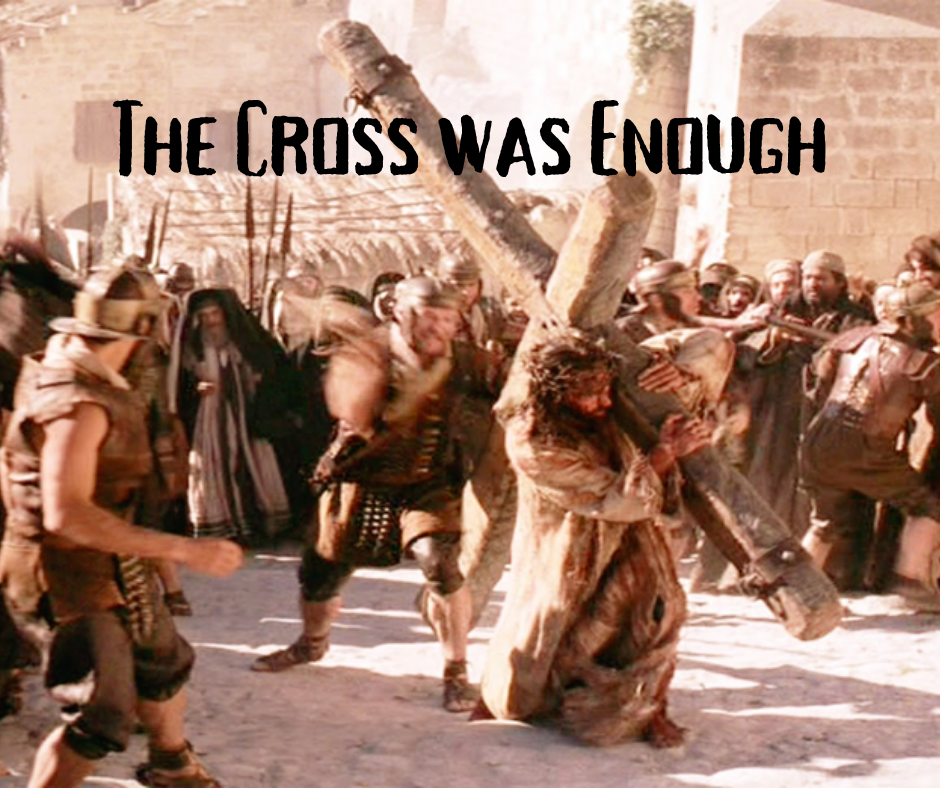
The Cross was Enough!

Recently, country music has been my new vibe! (Yes, I've even listened to Achy Breaky Heart) But my favourite is the song “The Cross Is Enough” by King of USA. (Probably AI)  But of course, the cross is not only enough, but it is also conclusive and the hinge of history. Everything before it pointed toward it. Everything after it flows from it. The cross is where God rewrote the story of the world with blood. Not with force and armies, but with the sacrifice of a Lamb. Rome thought they were executing a troublemaker. Hell thought it was silencing the Son. The disciples thought it was the end of the story. But Father was just getting started!

At the cross, Jesus purchased our freedom. He didn’t bargain with sin; he broke it. He didn’t just loosen the grip of death, He ripped the keys out of its hands. The cross is the place where God refused to leave us in the mess we created. He stepped into our darkness, took our guilt, carried our shame, and absorbed the wrath that should have fallen on us. Not to make us religious, but to make us His. The cross is where our Father declared, “You belong to Me.” Not because you were worthy, but because Christ was willing. The accomplishment of the cross is not just forgiveness; it is adoption. Not just pardon, but belonging.  And because of the cross, we are no longer defined by our past, our failures, our wounds, or our weaknesses. We are defined by His righteousness, His victory, His life. The cross where Jesus died, is the place where we begin to live.

Friends, this Easter, lift your eyes higher. Don’t just see a man on a cross, see the King on His throne. Thank Him that you are not simply someone God has decided to tolerate. You are someone He has chosen to love with the same love He has for His Son. You stand before God as if you had lived Jesus’ life, because Jesus suffered as if He had lived yours. The Cross was enough!

JIM Shaw
Hosanna

Four days before Passover, Jesus rode into Jerusalem on a donkey. It was the day of preparation, when Jewish fathers presented a spotless lamb to their household for inspection and the Father was presenting His perfect Lamb to the world. They cheered, laid down their garment to honour Him, saying, ‘Hosanna to the Son of David! Blessed is He who comes in the name of the Lord!’”  Matthew 21:7, 9.  Hosanna means “Lord save us”, but it was a political cry for liberation from Roman oppression. However, Jesus didn’t come to fulfil their political hopes but to fulfil the Father’s plan. He came to break the power of sin, not just the power of Rome. 

We are told that about the time that Jesus came in from the east side, Pilate was coming into Jerusalem from the west, riding a horse, flanked by soldiers, so there were two processions that day. Two kings. Two kingdoms. One represented earthly power, the other divine humility. One came to crush rebellion against the state, the other to atone for rebellion against God.

This historical moment is also a picture of our two options for how. The man on the horse represents human strength, control, and dominance. The man on the donkey represents God’s way—humility, surrender, and spiritual authority.

In a crazy world, we hope for great leaders who can “save us” or at least do something to bring the kingdom values of righteousness, peace and love to our land. But there can be no kingdom without the King. He must establish a kingdom in us before establishing a kingdom around us. The people wanted a revolution, but Jesus came to bring redemption; to change hearts, not just the government. Pilate’s kingdom would last a few more decades. Jesus’ kingdom has endured for over 2,000 years and will never end.

So friend, who will we cheer and trust in?  The secular state, world leaders, or Jesus. Paper tigers whose kingdoms will crumble, or the Lamb who rules forever? Choose your king. Choose your kingdom. I say, “Follow the One on the donkey even when He confronts our sin instead of our enemies. Let's lay down our cloak. Lift our voices and say. “Hosanna!: Save us,”  Save us from ourselves, not just our circumstances.

You do you

I was sitting on the inclined shoulder press at the gym when the gym instructor was urging some women nearby to push harder in their workout. One protested, “That’s too hard.” The instructor replied, “Fine, you do you.”

I’ve heard that phrase many times, and it always struck me as a bit woke and a bit weak. But as I inwardly scoffed, I felt like God was speaking to me. “You do you.”  As I questioned Him, it suddenly clicked.

“You are a son of God and a vessel filled with Another.
You house the Spirit of your Father, you are born from above and are one Spirit with God.
You are strong in your weaknesses, constrained by His love, and have the mind of Christ.
You shine as light in darkness, and you are alive for such a time as this.  So “You do you.”  in other words: Be who I made you to be.

We've had this talk before, but I was encouraged and excited. I said, “All right, Lord — I’m ready to be me.” Almost immediately, a man walked up to me on his way to the spin cycles to talk about the Holy Spirit. I encouraged him to go deeper and reminded him that we need all the power of the Holy Spirit we can get.

On the lateral Pulldown in front of me was a man I had prayed for years before. I had forgotten his name but asked him if he was doing well, and he told me about his nail-punctured foot. I took the opportunity to pray for it.  He thanked me. Most sinners love prayer.

Over by the window was a man I had never seen. I felt the Holy Spirit gave me a word and shared that God was calling him to influence young people. He replied with a smile, “Yes and tomorrow I fly to Christchurch to start as a youth pastor. Perfect timing!

On my way out, I spotted Moko, who told me he used to play gospel songs as a kid. I went over and said, “Kua mutu taku korikori. Kei te haere au ki te kāinga. Kia pai te rā.” (I'm finished and going home). I’m learning te Reo because it’s a missionary principle — when you go to a country, learn the language. (The TV1News is helpful.)

Walking back to my car with Jesus, we smiled together. Again, “If you do you, I can do Me”.

Friends, in God’s family, Emmanuel is always in us and with us. You do you — because we are His hands and mouth, and when we do, people’s lives can change. When we do what He made us to do, He can do what only He can do.

The Divine PurposeJIM Shaw
Waitangi

Today should be a celebration of the gospel of Jesus. In all the tension around the treaty, we can forget the massive role that Christianity played. The missionaries were the strongest advocates for Māori. They pushed for British law to restrain lawless settlers. They defended Māori rights and land. They opposed the New Zealand Company’s aggressive colonisation. They urged the Crown to protect Māori from exploitation. They helped both sides understand one another, encouraging chiefs to sign because they genuinely believed it would safeguard Māori wellbeing. Missionaries were trusted by the chiefs more than the Crown itself. Hōne Heke and Tāmati Wāka Nene both cited their Christian faith as a reason for signing. After the signing, Hobson shook hands with the chiefs and said, “We are now one people,” echoing Galatians 3.28.

The Christian worldview of the missionaries shaped the framework of Te Tiriti. They believed people would value honesty and honour agreements because they feared God. The Treaty was signed by believers—Hobson, Busby, with Williams and Clarke present, and 500 Chiefs. At the time, almost half of Māori in NZ were following Christ. But things have changed. Many political leaders now reject God, refusing to honour Him or seek His help, and many Māori are returning to animism. It is unrealistic to reject God in parliament yet expect Him to hear prayers on the Treaty grounds, just as it is unrealistic to expect Maori to find peace without forgiving. The tension we feel today is that a document shaped by Christian thinking cannot be lived out by parties who no longer think Christianly. Covenant thinking requires faithfulness, honouring God, and honouring one another. When that is lost, relationships collapse into leverage and mistrust.

Obviously, what would help the Treaty to work as intended would be for all parties to return God. Reconciliation is not political and not another handout; it is relational. It looks like bowing together before Jesus, receiving God's mercy and grace, humility, listening, forgiving, and rebuilding trust. It means acknowledging pain and also the blessings that came from the arrival of Pakeha. The Treaty matters because people matter. In the meantime, believers can live as one people even when others do not. We can acknowledge progress, pursue justice without hostility, and remember that without the gospel, today’s debate is like arguing over who gets to be captain and who will have the biggest cabin, all while the boat is sinking.

On the Other Side

When Israel faced the towering walls of Jericho, they believed God's words and acted boldly. It required something from them before God’s plans could continue to unfold.

Many years ago, when I was new in ministry, a minister asked me to sit in on a deliverance session. It was an education. The woman was a mature believer, with a solid marriage and a respected position in the church. She confessed to sexual activity with incubus demons. She was ashamed and exhausted, but she asked for help. That moment was one of the greatest demonstrations of courage and humility I have ever seen. She stepped into the light. And God met her there. She was wonderfully delivered, and of course, thankful.

The old hymn says, “The way of the cross leads home.” In my experience, the way of courage and humility isn’t just the way home — it’s the way forward in almost every area of the Christian life.

Successful relationships take bravery and humility. To bring up issues honestly with grace and for the other to respond without defensiveness.  If the issue isn’t resolved, it takes courage and humility to keep loving them until God brings a breakthrough.

To move into new levels of ministry takes courage and humility, because nobody gets it right the first time. To move in the gifts of the Spirit, whether on the street or in the church, also takes courage and humility. To grow and go forward, we all have to do the hard things, as did Jesus.  To fulfil His Father's purpose, He showed God-sized courage and unspeakable humility on the cross, for us.

Friends, as we step into 2025, I’m not predicting the annexation of Greenland, the rise of the Nephilim, the Ezekiel 38 war, or the removal of presidents or pastors.  But I will predict this:  We will need to grow in courage and humility, because every step forward in the Kingdom requires both. If you face a “wall”, be courageous, consider Jesus and take action because God's planned future for you is on the other side of your wall.

Be strong and courageous… for the Lord your God is with you wherever you go.” — Joshua 1:9

Sin

God emptied heaven to bring us back to Him by sending His Son on a mission. God said to Joseph, “Call him Jesus, because he will save his people from their sins.” God saw the manifold sufferings of people, but He was dealing with the root of our problem, because humanity’s deepest issue is not economic, social, racial, or educational—it is sin. Today, the media pours out details of the hate between nations, neighbours, and bus riders, but they never mention the Hope: Jesus Christ, who came to save us.

When a PhD cheats on their taxes, and a school leaver pays theirs, the difference isn’t education; it’s sin. When MPs on both sides of the house commit adultery, the issue isn’t politics; it’s sin.  Both rich and poor can become depressed or suicidal, because the cause isn’t money; it’s sin. When suburbs with the greatest public amenities and services still lead in social problems, it's not the environment; it is sin.

Socialists insist our problem is financial inequity, solved by redistribution and taxes. Humanists reject the idea of sin, but, embarrassed by growing evil, blame society and its institutions. New Agers and Avatars tell us cosmic consciousness will solve our problems, but our “godness” is slow coming. Secularists place their hope in technology, but our kids are emotionally sicker. Some psychologists say people's problems come from the suppression of desires and instincts. But their solution to release those drives to be “free,” sounds dumb to me.   Atheists claim that everyone is without sin and is evolving towards utopia. I haven't noticed. They confuse capacity with choice: Though we are created for worship and love, we still choose wrong. So the Scripture is true, “All have sinned… and fallen short of God's requirement” (Romans 3:23).

Everyone has a diagnosis and a cure. But if the diagnosis is wrong, the solution is hopeless. By all means, let's help the poor, alleviate symptoms and suffering and educate all who want to learn. But until we realise the problem is not in our purse or in our parliament, but in our hearts, true change can never come. Only the blood of Christ removes the guilt of sin. Psychiatry may expose it. Psychology may help us cope with it. But only Emmanuel—God with us—can pardon it and remove it. Only Christ the Saviour can save us from the penalty and the power of our sin. Thank you, Jesus!!

Ps. Have a brilliant Christmas celebration with your family and friends. See you in 2026!

The Divine PurposeJIM Shaw
Ancient Darkness

Ancient darkness whispers through ancestry, culture, and superstition. The Jews in John 8 clung to Abraham’s name, convinced their genealogy guaranteed God’s favour. But Jesus shattered their illusion: “Your father is the devil.” Pride in their past blinded them from seeing God in the flesh standing before them.

Their ancestors had wandered, been exiled, colonised, and mistreated. Survival stories became identity anchors, but identity rooted in history or offence didn't grant salvation.

Some ancient peoples worshipped the true God of Abraham. Others bowed to animist spirits dwelling in the wind and stones, or to pantheist visions of a divine creation and universe. My own Celtic forebears revered ancestors, feared curses, and read omens in shadows. Bagpipes I love; haggis, not so much. But superstition and mythical gods bound them to fear, not freedom. Even today, international recognition and adoption of indigenous knowledge is not a path into the light.

Jesus spoke to this confusion. He says: “My words are the Truth; if you follow them, you will walk in freedom.” He and His words are the measure of reality itself. And He warns: “If anyone from any age or place isn’t following me, they walk in darkness.”

Friends, culture is a gift. Language, food, family, and traditions should be celebrated. But culture cannot save. Genealogy cannot redeem. The Jews were culturally awakened but spiritually blind. Embrace what Christ redeems in culture, reject what enslaves, and remember: Jesus alone reveals the Father. He is the Truth, the measure of all knowledge, the light that shatters ancient darkness.